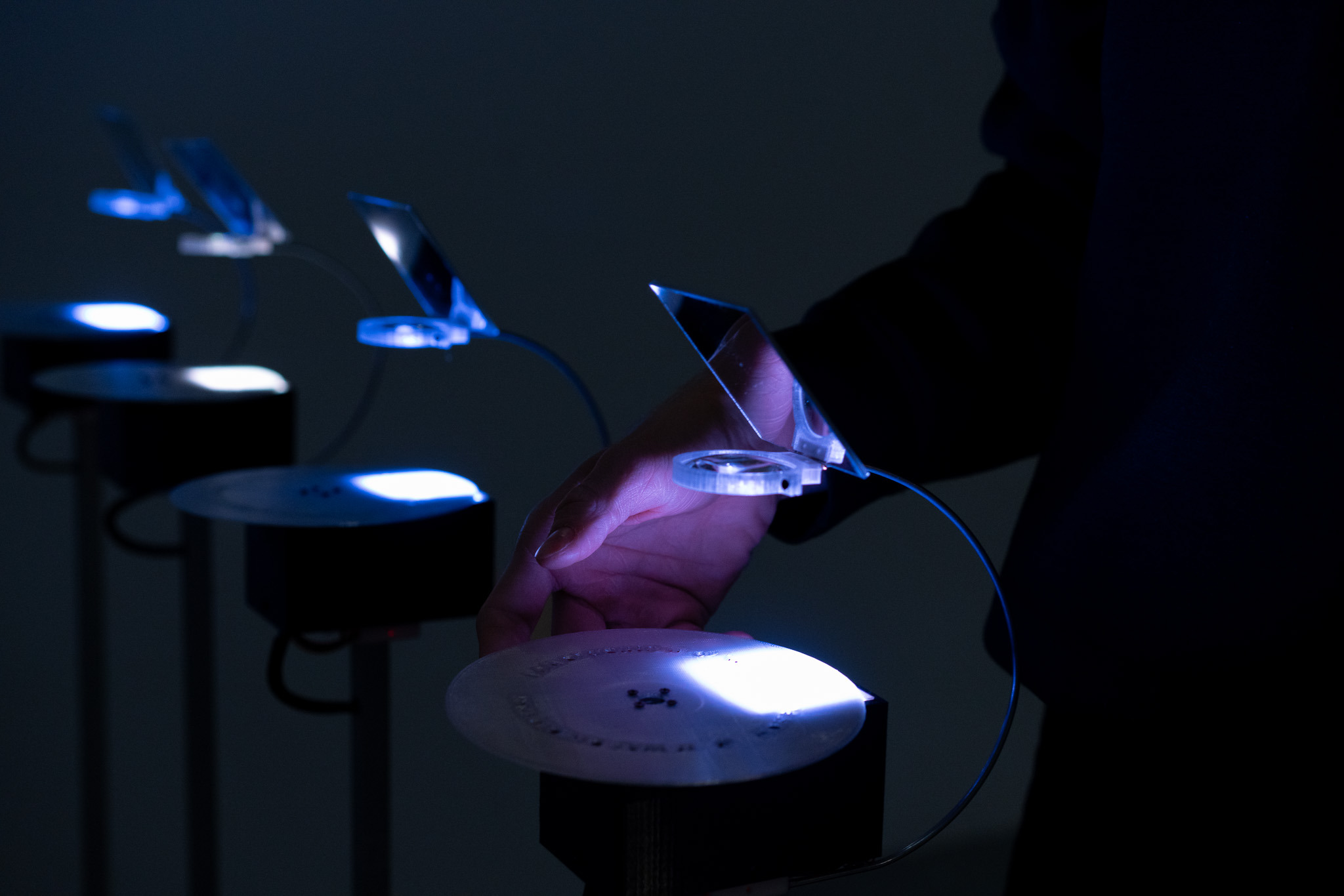
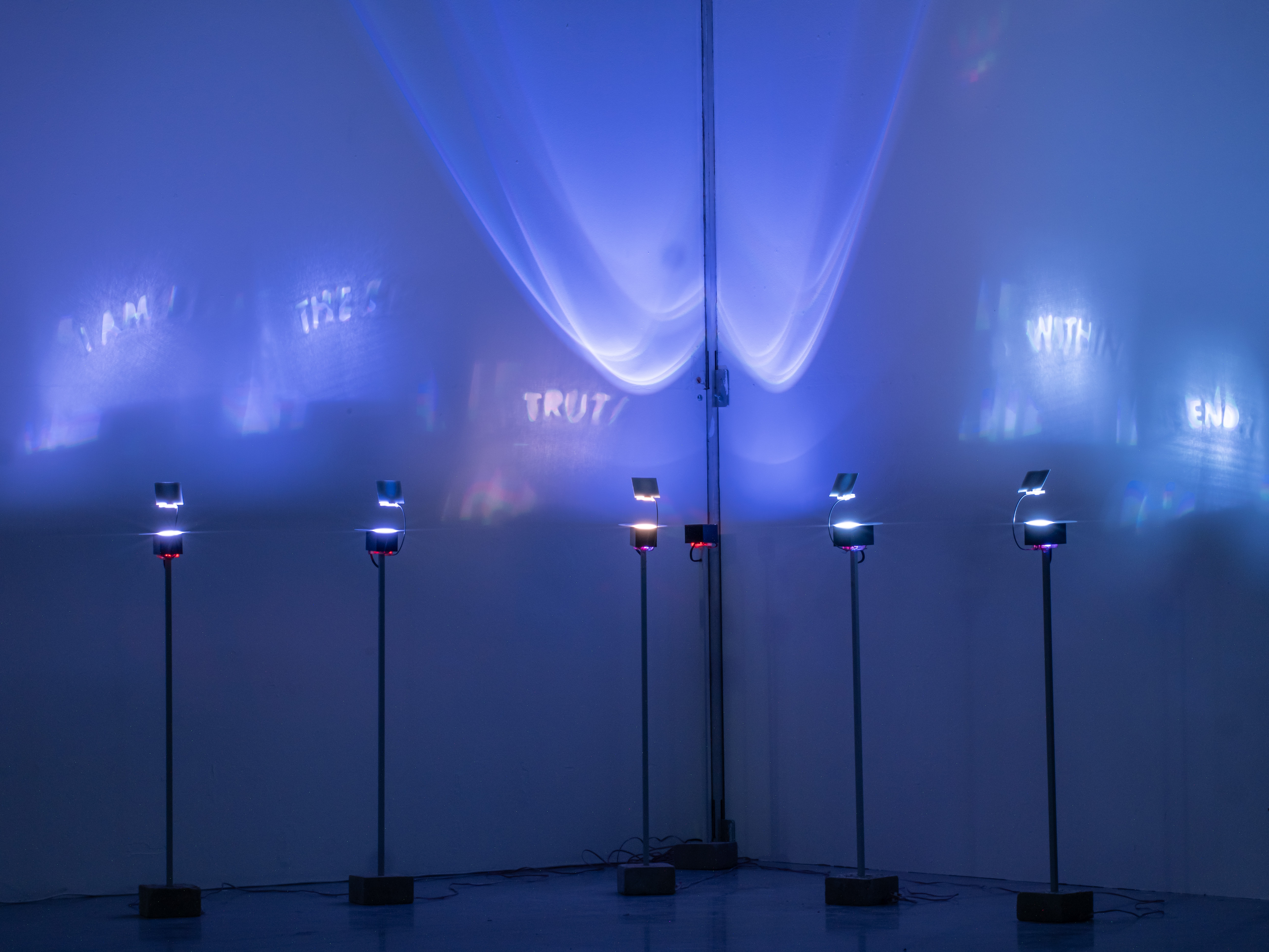
Still Being Written As Written Being Rewritten is an interactive installation of seven custom-built overhead projectors, each casting a fragment of a modular sentence onto the wall. Each disc holds three versions of a word: what was decided, what is being decided, what will be decided. A visitor turns one disc. The remaining units follow in a chain reaction. The sentence reassembles itself around the new choice.
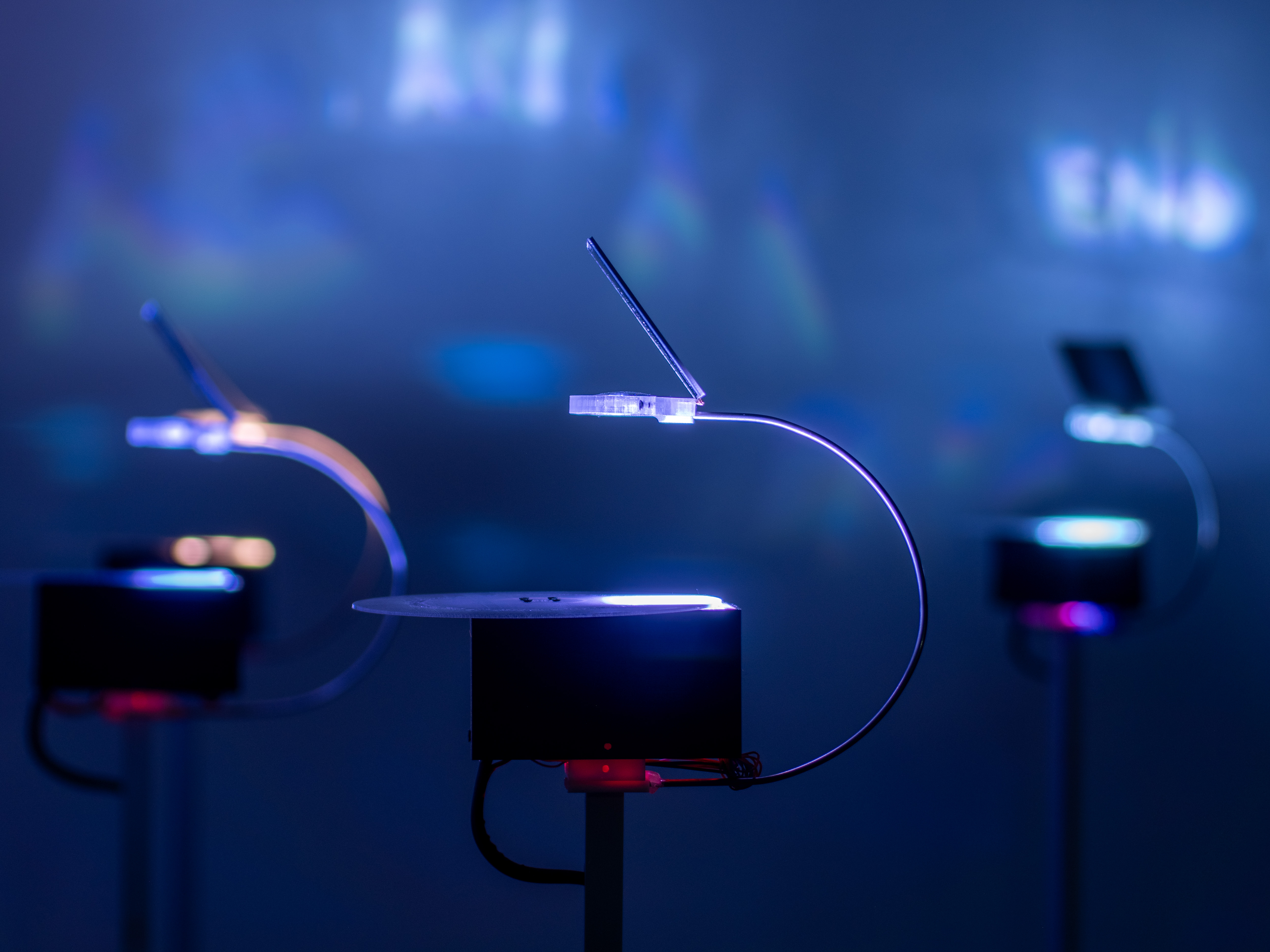
All human languages are inherited. With them come not only words but structures of power — who speaks, who is spoken about, what counts as having happened. This project begins from the observation that grammar is never neutral: a shift in subject, tense, or verb redistributes agency and rewrites what is possible. By making that shift physical and immediate, the installation proposes a language that does not accumulate into fixed history. The past is not sealed. It turns.
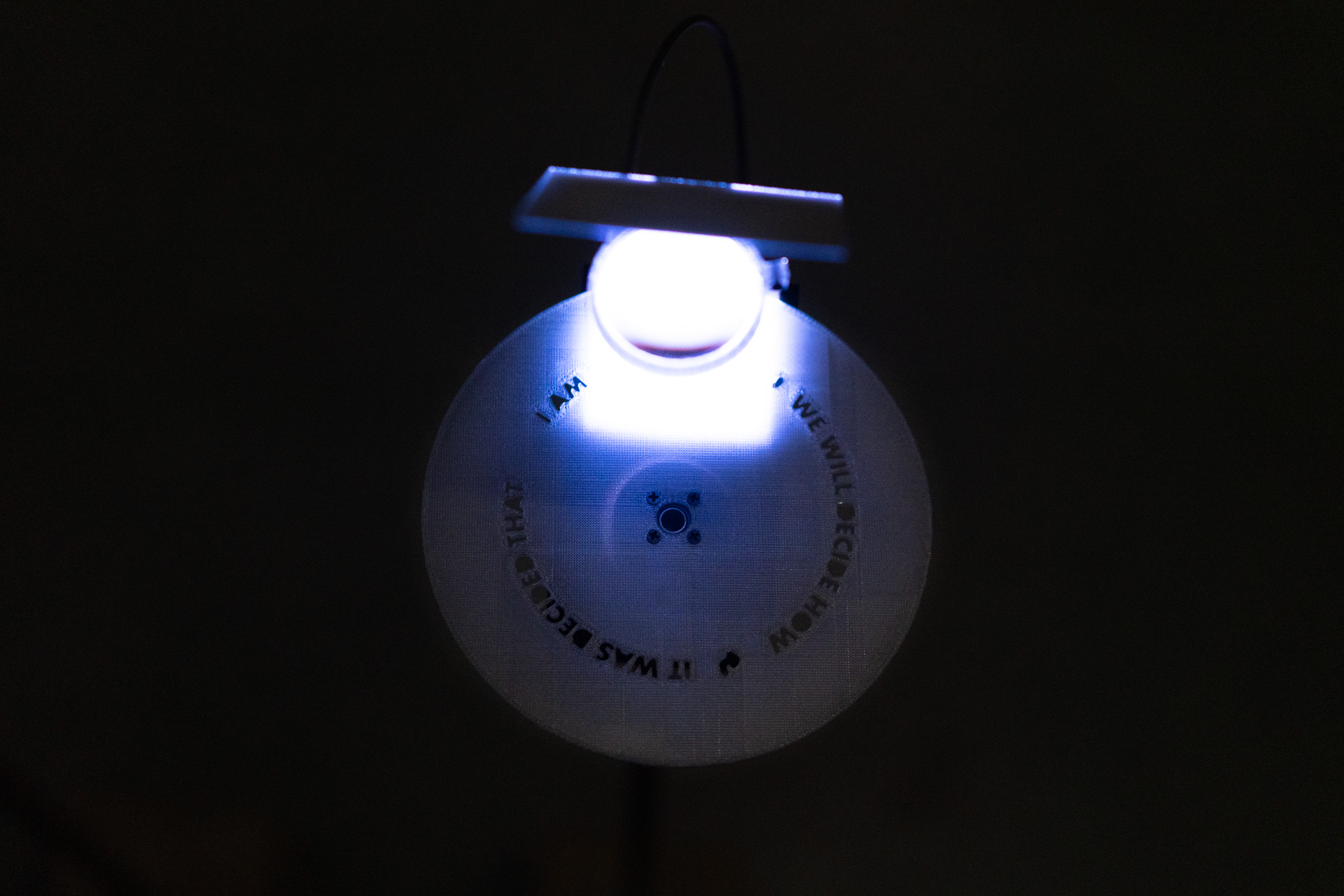
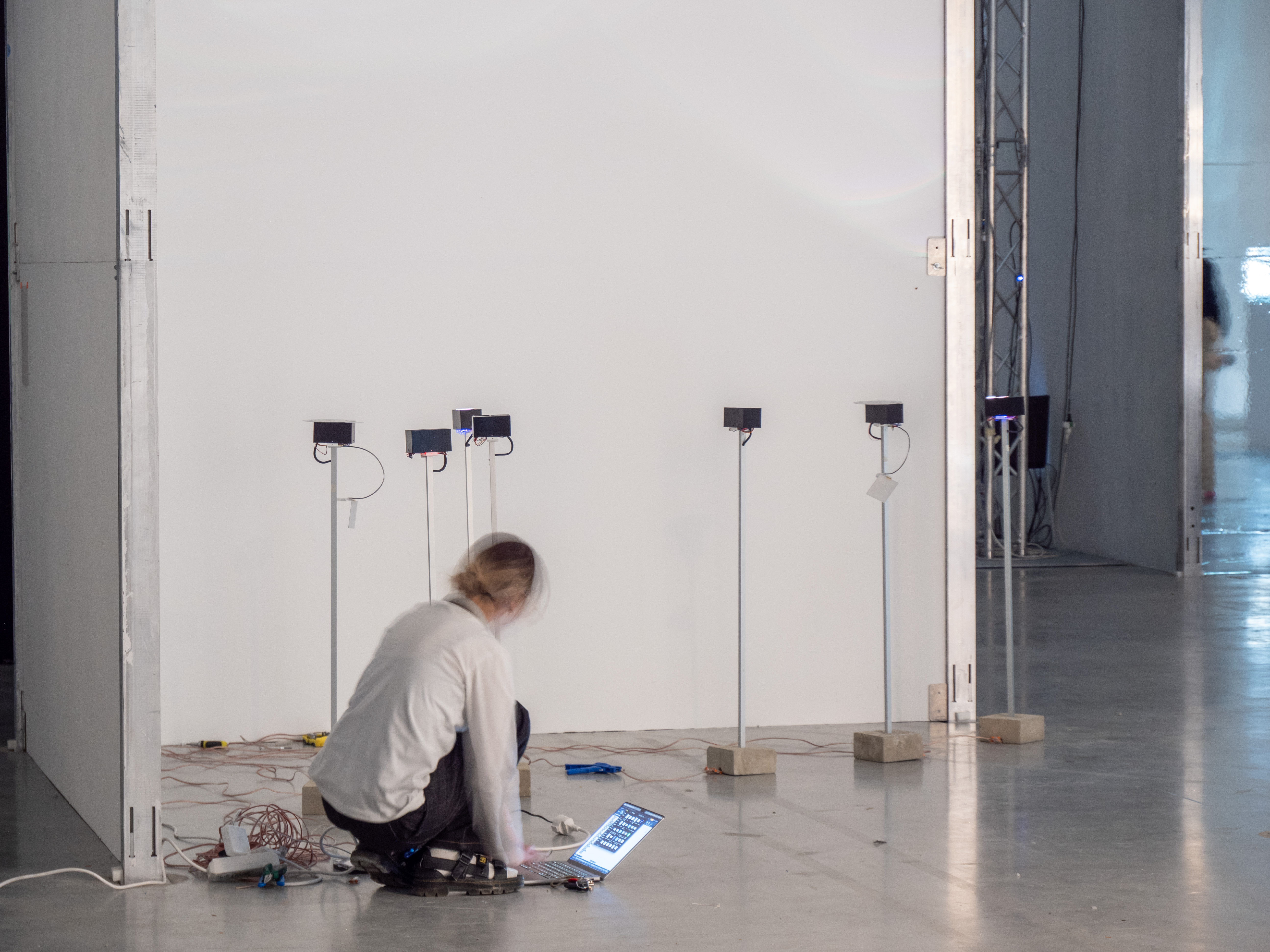
The installation consists of seven custom-built overhead projectors, scattered across the space. Each projector is embedded with a motor that functions as a rotary knob. Mounted on the motor is a disc, stencil-cut with fragments of speculative writing. As the disc turns, the text is projected onto the wall.
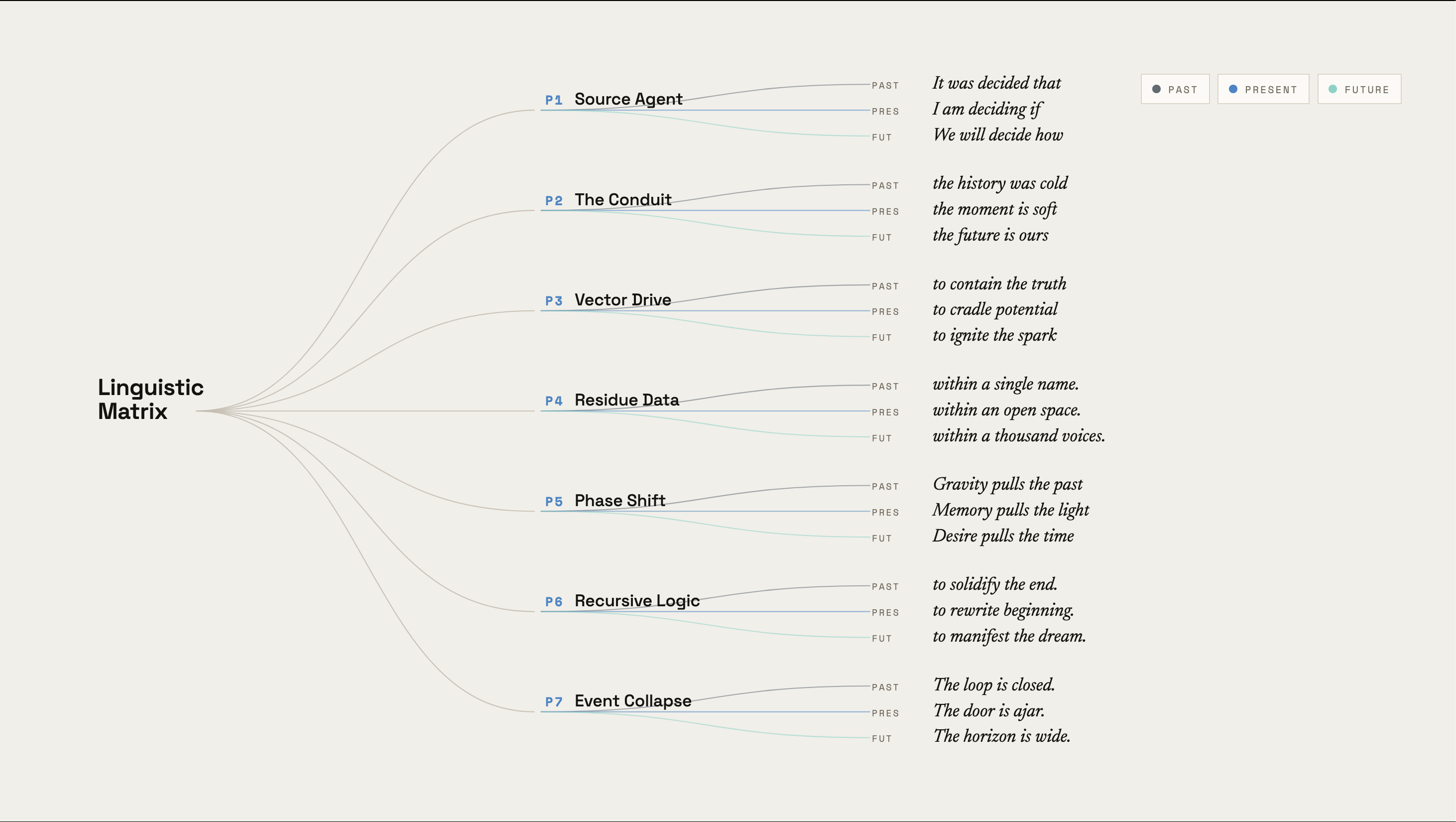
Each disc carries three fragments: a past, a present, and a future. Together the seven units form a single modular sentence, split across seven parts. Each part holds its own three moments: the decided, the deciding, the will decide. They are displayed equally. No state is the default. No state is the destination.
A visitor can rotate any one of the seven discs. The remaining units respond, turning to follow. The initiating unit changes, and the others reconfigure around it. The full sentence shifts. A new combination of past, present, and future assembles across the room.
Concept
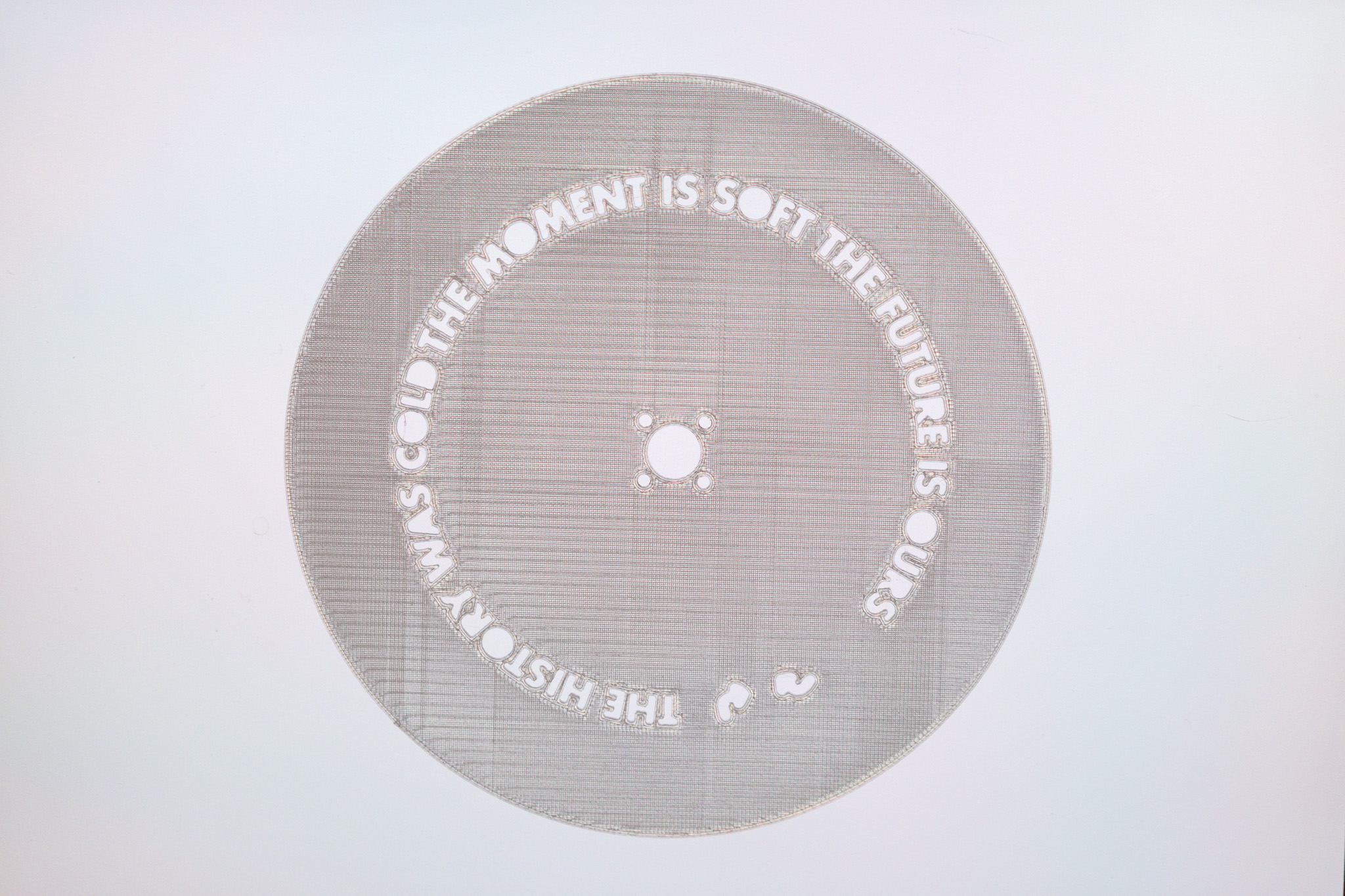
All human languages are inherited. They are passed down from somewhere, by someone, through a source that precedes us. With them come context and logic, preference and habit, bias and belief – along with pride, privilege, fear, and stigma. This raises the question of whether power is inseparable from language itself.
Wherever language is shared, power emerges through fluency, access, authorship, and control. Language carries the weight of cultural memory; its authority depends on stability and repetition. Stigma does not appear from nowhere. It accumulates, it sediments, it is passed down the same way a word is passed down. It needs heritage to stand on.
What if that foundation could be rewritten? Not erased, rewritten. In a language where a word can be reversed, forwarded, where the sentence does not describe what happened but decides it, stigma loses the ground it builds upon. Power may still exist in any given moment, in whoever is holding the dial. But it cannot harden into history. It cannot become inherited.
This possibility is grounded in physics before it is grounded in politics. The block universe model proposes that past, present, and future coexist simultaneously within a four-dimensional structure. It is only the limits of human perception that confine us to the present moment. Retrocausality takes that further: a decision made in the present can reach backward and alter what has already occurred. This project applies both ideas to language. A singular moment, a word, a verb, a pronoun, can be reversed, forwarded, rewritten.
The linguistic matrix is a disc with no end. Each unit holds three states of a sentence: past, present, future. The form refuses linearity. There is no first position and no final one. The sentence does not conclude; it turns.
The matrix operates like Le Guin’s carrier bag, a surface that holds multiple moments simultaneously, without resolving them into one. It does not choose between past, present, and future. It preserves all three. To preserve is not to privilege. The matrix holds past, present, and future on the same surface, at the same weight. No state stands above another. There is no origin to obey, no conclusion to reach.
Sontag observed that words have their own firmness, that a thought gains clarity, definition, and authority by being put into print. This project accepts that observation and works against it. What if the written word did not fix but opened? What if language on the page could still hold multiple voices, leave room for imagination, remain fluid in the hands of whoever reads it?
This project is a speculative observation of an imagined reality, one where stigma cannot build upon heritage, and words exist only as free expression.
Technical Details
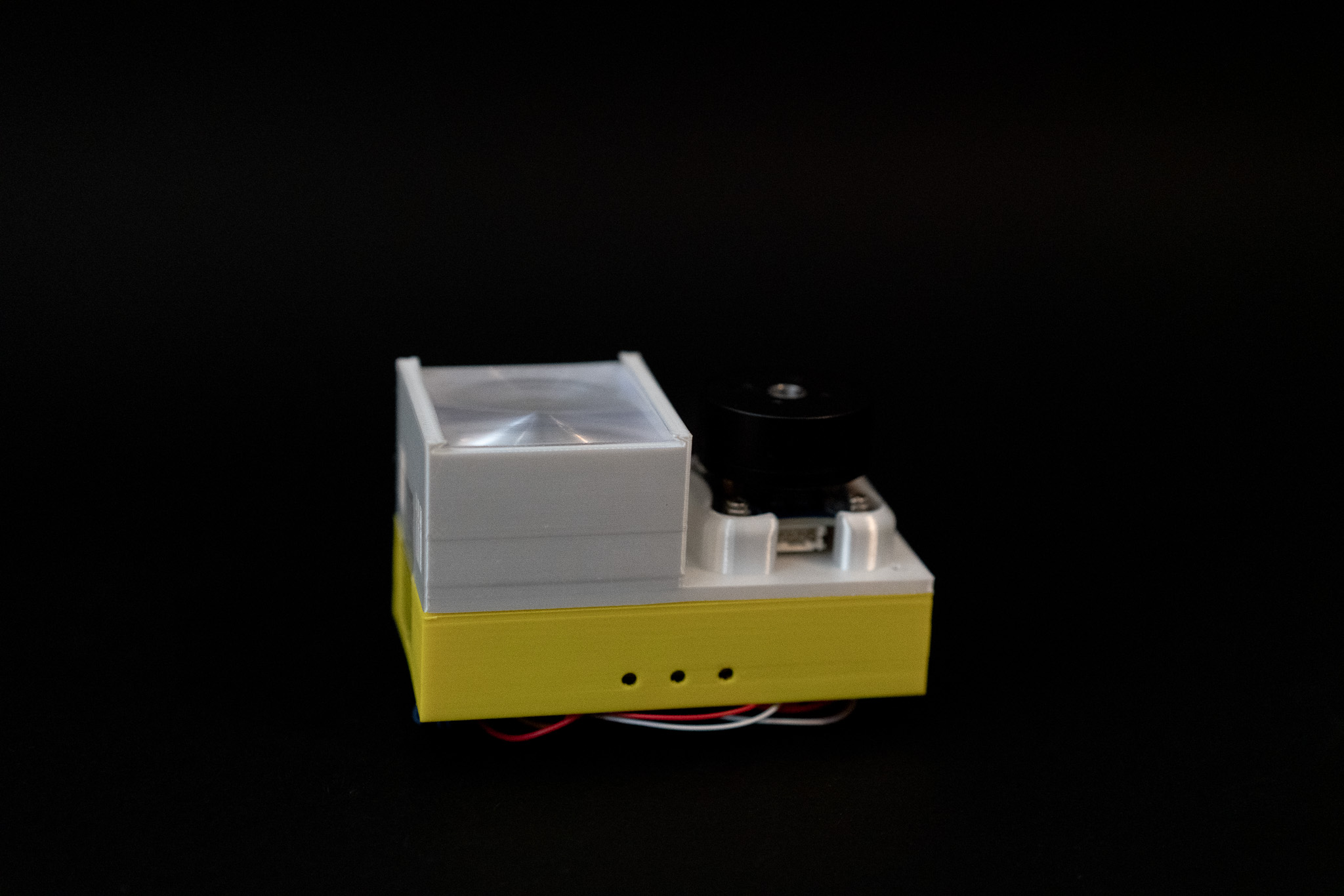
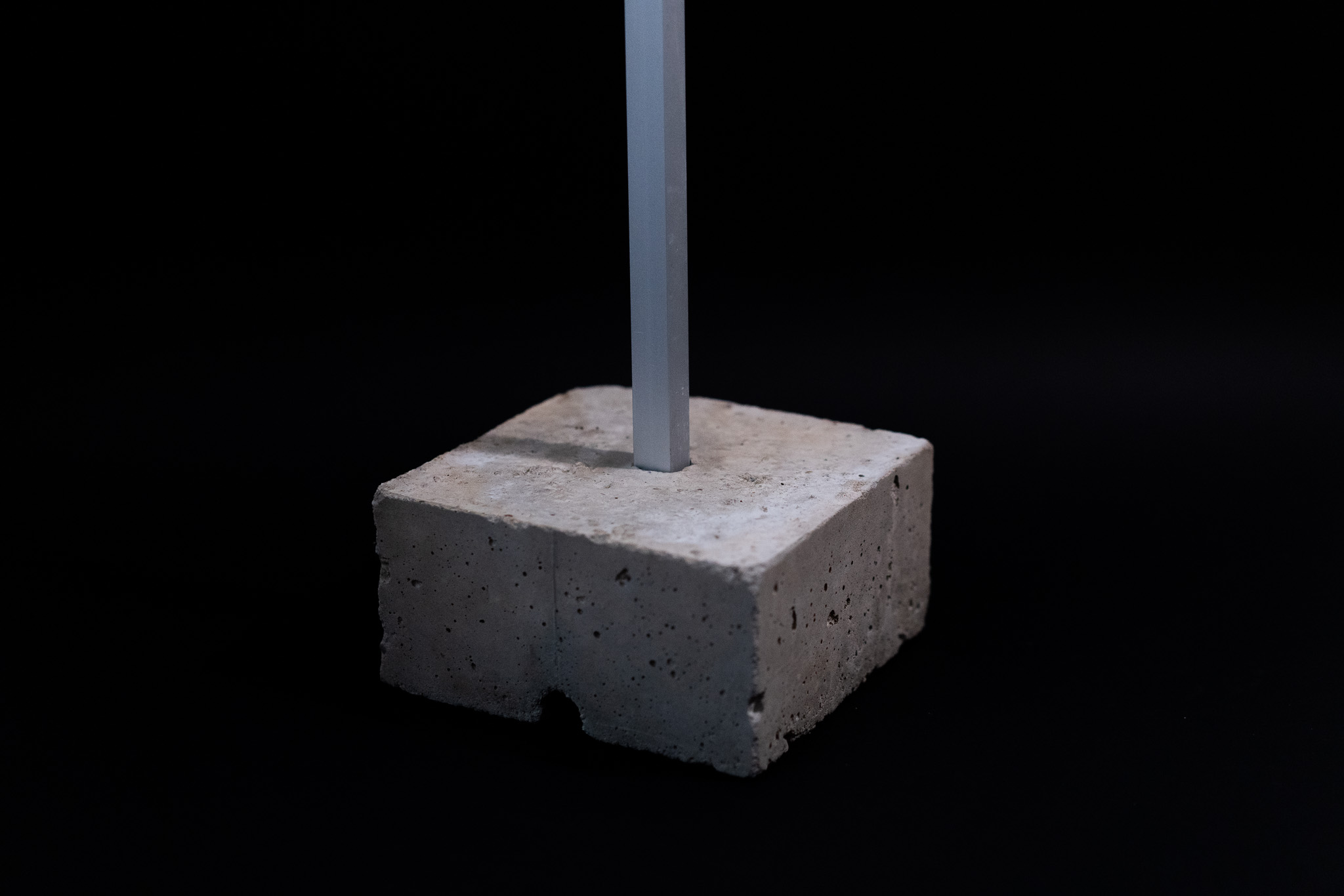
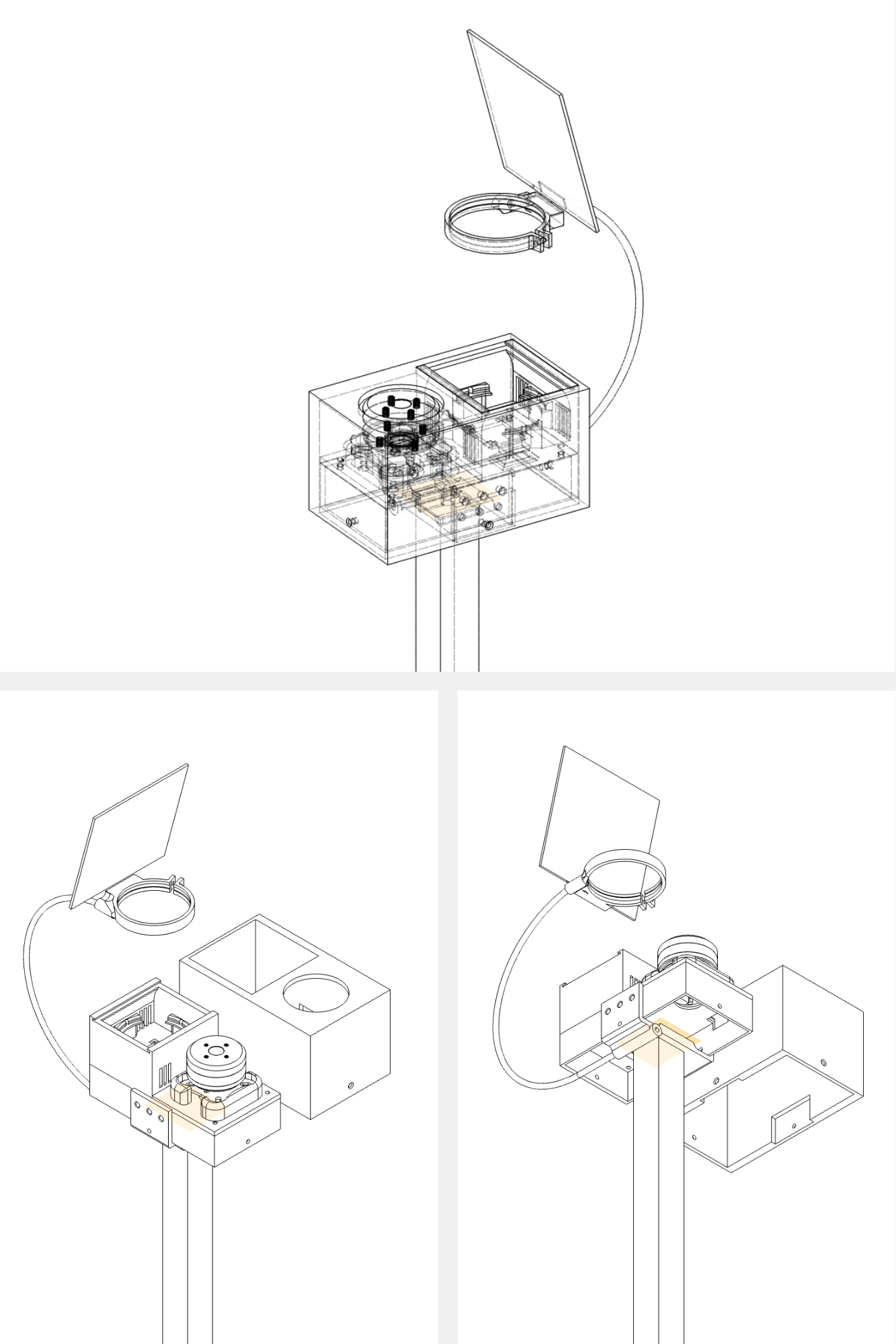
Each unit is built after the principle of the overhead projector. The body is fully 3D printed, housing the electronics and optical components in precise alignment. The unit sits on an aluminum profile with cutouts to conceal wiring. The base is custom cast in concrete, 3D modeled and hand-cast individually, providing both stability and a material contrast to the printed body.
The light source is a WS2812B RGB LED panel, with four LEDs allocated per projector. Light travels upward from the LED through a condenser lens, then a Fresnel lens embedded in the top of the box body. Above the box sits the stencil disc, 3D printed and precision cut with the speculative text. The disc is mounted directly onto a 2804 brushless DC motor, which rotates it from below. A wire, hand-bent into a half-circle form, carries the lens and mirror module above the disc. A second condenser lens captures the light passing through the stencil, which is then redirected by an angled mirror onto the wall.
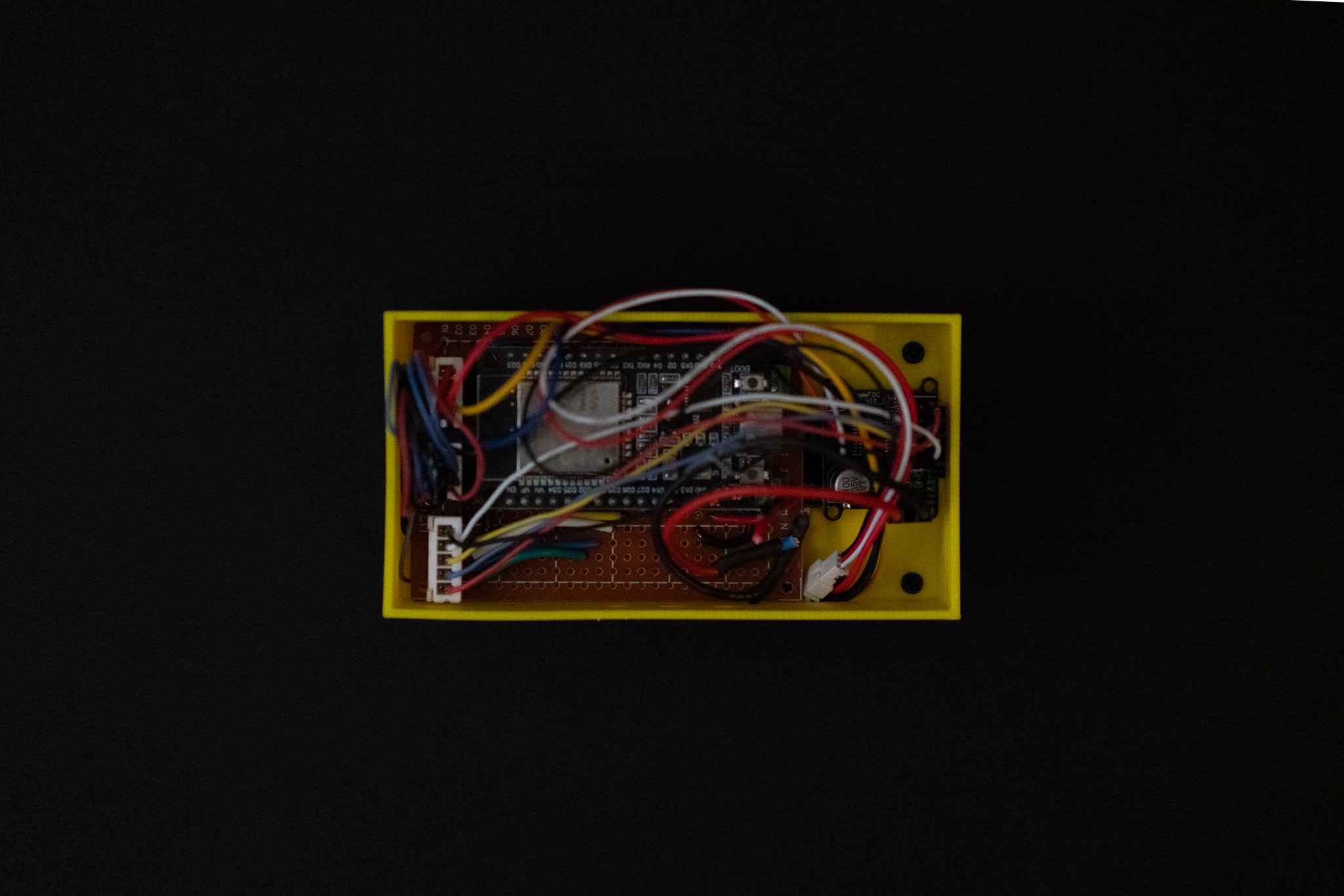
The rotary interaction is driven by the motor itself. An AS5600 magnetic encoder reads the exact rotational position of the disc at all times, registering when a visitor turns it by hand. Each unit is controlled by an ESP32 microcontroller. The ESP32’s built-in wireless communication module enables a cable-free setup between all seven units. The circuit for each unit is organized on a protoboard. A custom PCB was designed for the setup but due to time constraints the protoboard solution was used for the final exhibition.
All seven units communicate via ESP-NOW, a lightweight wireless protocol native to the ESP32. A single broadcast message carries both the motor angle and the LED color state simultaneously. When a visitor turns any disc, that unit becomes the initiator and broadcasts its state to all others. The remaining units respond by rotating their motors to the matching position. Any unit can override and become the new initiator at any moment.
Communication
typedef struct struct_message {
    float angle;       // motor position
    uint8_t r;         // LED color red
    uint8_t g;         // LED color green
    uint8_t b;         // LED color blue
    bool isInitiator;  // is this unit currently initiating
} struct_message;
void OnDataRecv(const uint8_t *mac, const uint8_t *incomingPacket, int len) {
if (incomingData.isInitiator) {
target_angle = incomingData.angle;
syncTargetColor = CRGB(incomingData.r, incomingData.g, incomingData.b);
lastInitiatorActivity = millis();
isRespondent = true;
if (!isDeskRespondent) motor.enable();
}
}CRGB getLocalColor(float angle) {
float normalizedAngle = fmod(angle, 2.0 * PI);
if (normalizedAngle < 0) normalizedAngle += 2.0 * PI;
float phase = (deviceRole / 4.0) * PI;
float cycleAngle = fmod(normalizedAngle + phase, 2.0 * PI);
float ratio = (cycleAngle <= PI) ? cycleAngle / PI : (2.0 * PI - cycleAngle) / PI;
return blend(CRGB::White, CRGB::Blue, ratio * 255);
}Development Process
The development of the installation moved through three distinct phases: an initial prototype built around a different optical and interaction principle, a technical consolidation into the final hybrid structure, and a final push toward a clean, exhibition-ready form under significant time pressure.
The first public showing was a rehearsal exhibition, where a working prototype was presented. The interaction mechanism at that stage was a barrel structure inspired by the magic lantern: a cylindrical form with a light source housed inside, and a potentiometer attached to its side to measure rotation. The optical principle was different from the final work — cruder, more exposed, but functional enough to test the core idea of turning as a grammatical act.
The design was quickly abandoned after the rehearsal. The barrel structure was limiting in scale and precision. The next iteration drew from two new references: the armillary sphere and the overhead projector. The final unit is a hybrid of both — the disc and rotary logic of the astronomical instrument, and the lens-mirror optical chain of the overhead projector.
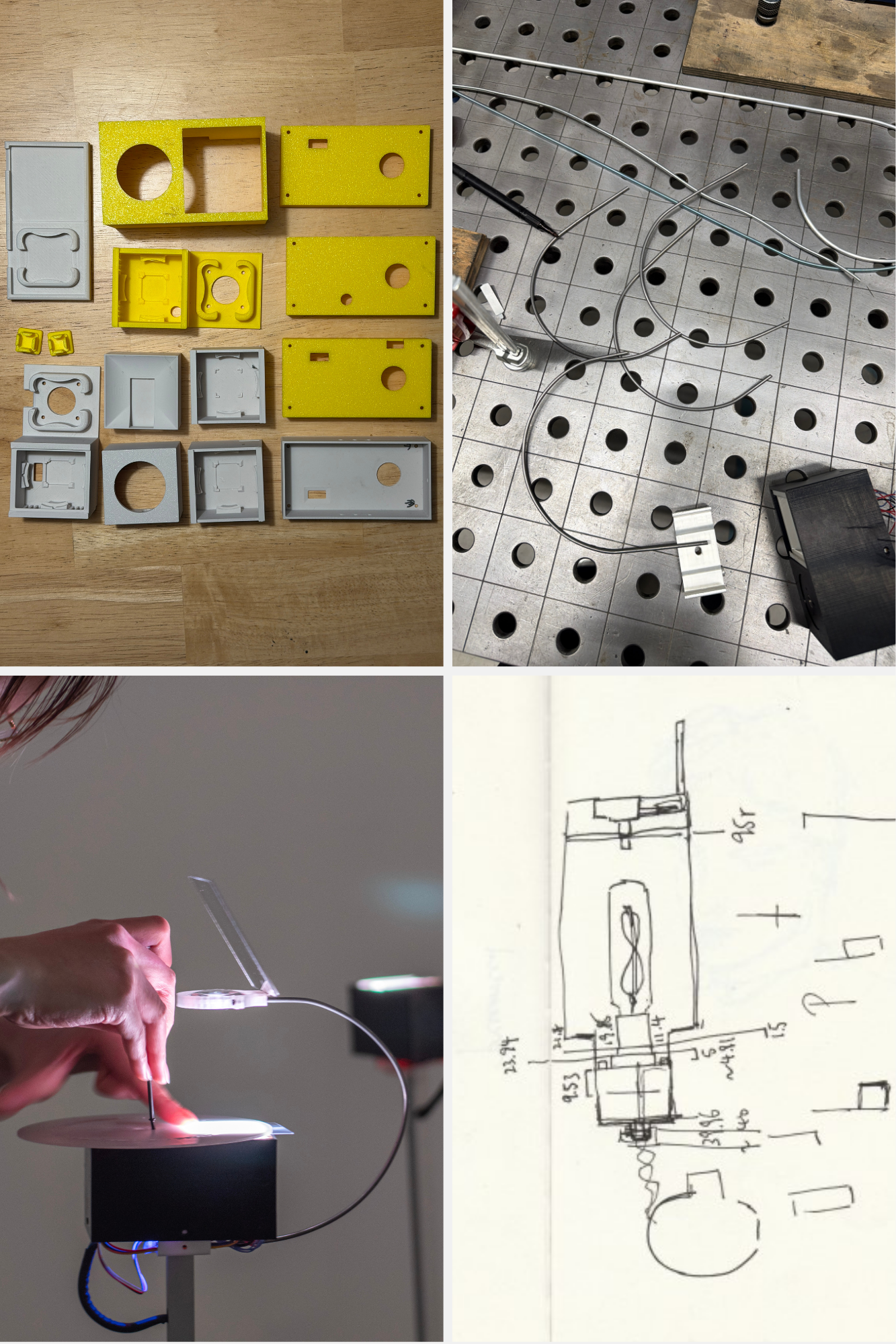
The shift to BLDC motors brought both precision and difficulty. The motors are compact and encodeable, well suited to the small form of the unit. But synchronizing seven of them wirelessly proved complex. The core problem was determining when a rotation begins and when it stops — the system would get stuck in a continuous loop, units endlessly broadcasting and responding to each other.
The solution was a combination of a movement threshold and a timeout window. A rotation is only registered as an initiation if the disc moves beyond a defined angle. Once initiated, the unit broadcasts its position at 50Hz for a fixed window of 2 seconds. If no further movement is detected within that window, the unit returns to idle and stops broadcasting. This gave the system a clear sense of when a gesture starts and ends.
The choice of light source went through several iterations. During the rehearsal exhibition, an iPhone flashlight was used inside the barrel — it produced strong, clear projections but was clearly a temporary solution. The final work uses a WS2812B RGB LED panel, four LEDs per unit. The panel requires very little power, fits within the constrained space of the 3D printed body, and allows color control tied directly to the motor angle.
Once the optical and mechanical components were consolidated, the full circuit was designed in KiCad for PCB production.
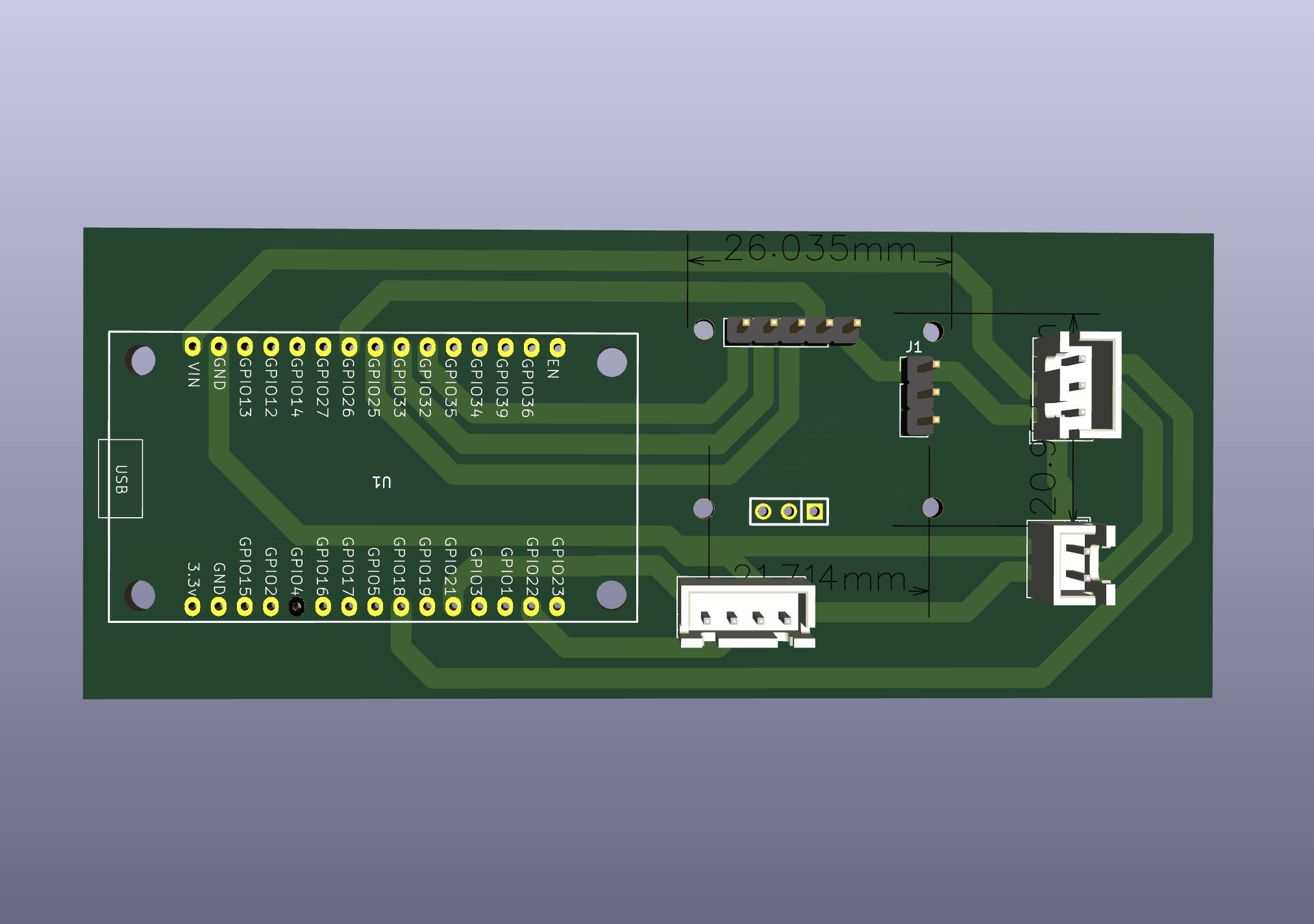
Time pressure led to an alternative approach: 3D printing the circuit board with copper tape as routing. This method failed. The connectors were too small and the printed material too heat-sensitive to solder reliably, leaving almost no margin for error.
The fallback was protoboard. This introduced a new problem: the installation runs on a 12V 20A power supply, and the protoboard traces could not carry that current to the motors. The LED and ESP32 communication worked successfully, but the motors could not be driven. This remains an open problem to be resolved in a future iteration, where a properly manufactured PCB will replace the protoboard entirely.
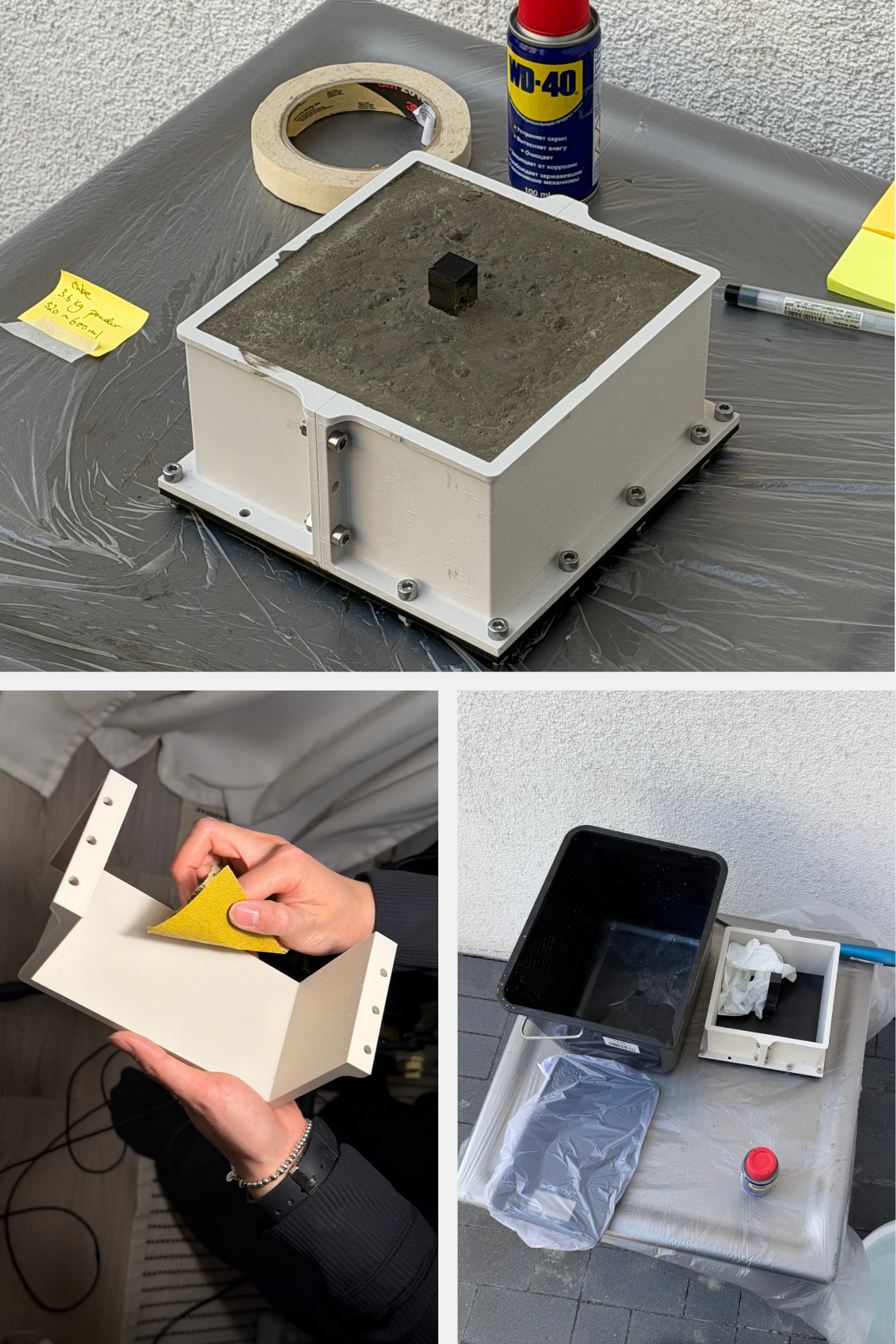
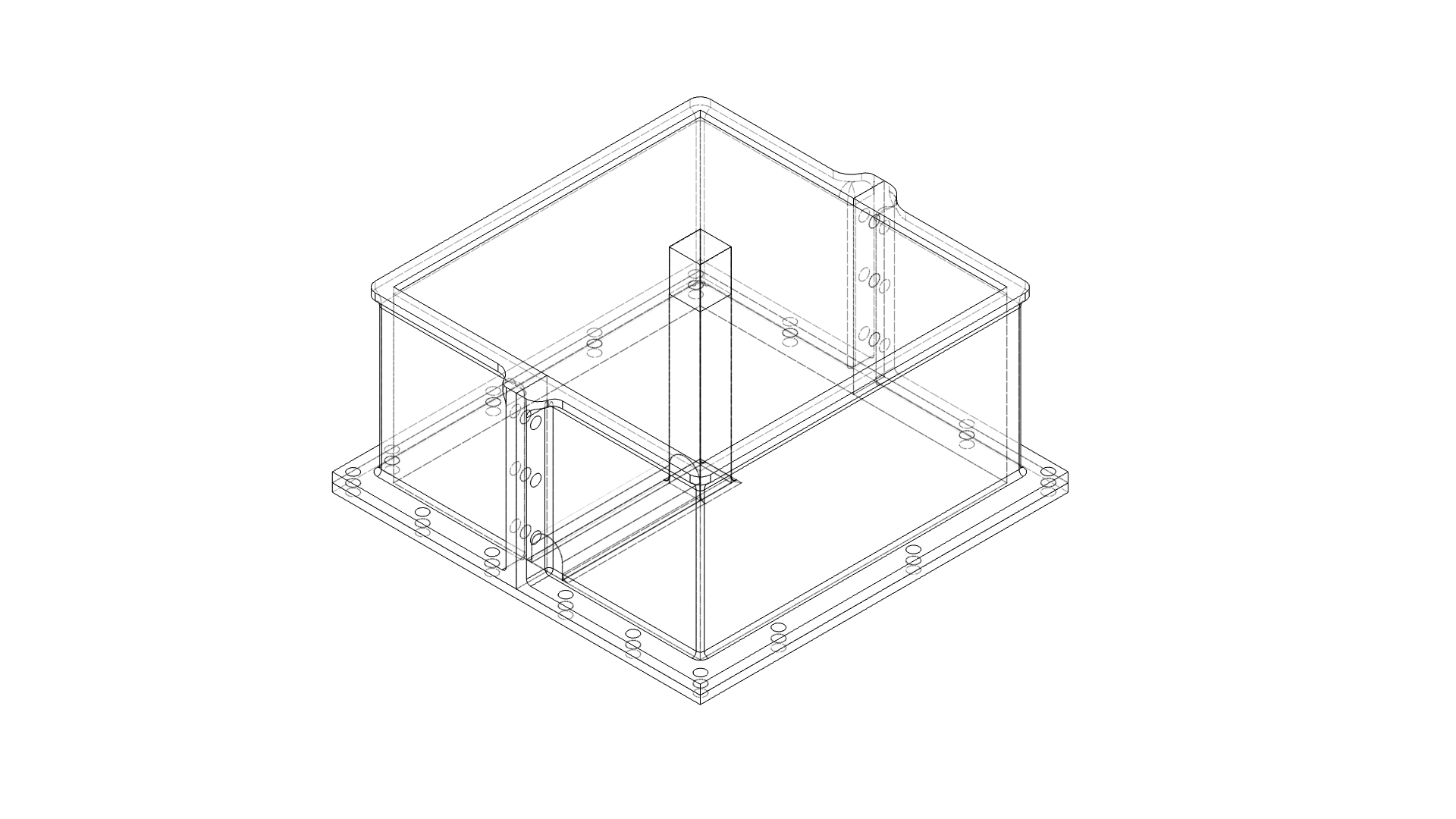
Despite the technical constraints, the decision was made to present the work as cleanly as possible. The housing for each unit is fully closed, a tight-fit 3D printed body with little visible wiring or electronics. Seven hollow aluminum profile poles with internal wire slots serve both as stands and as conduits for the power wiring. The bases are cast individually in concrete, from 3D printed molds. The material choice was deliberate: the weight of concrete provides stability for the one-meter-tall units, and the contrast between raw cast concrete and smooth aluminum profile reflects the tension between material permanence and mechanical precision that runs through the work.
Special thanks for the mentorship of Prof. Dennis P Paul, Prof. Ralf Baecker, Prof. Petra Klusmeyer. And fellow colleagues who are also part of the Digital Media Master Project exhibition.
Project was developed under support of HfK Bremen.