Talking to Others explores the dilemma of Chinese as a logographic language forced to function within an alphabet-based technological framework — from the Chinese Telegraph Code to the QWERTY keyboard.
The Chinese Telegraph Code (CTC), invented in 1871, was the first attempt to bring Chinese into a modern communication system. Rather than accommodating the nature of Chinese as a logographic script, the CTC encoded a selection of characters as four-digit numbers — reducing the language to a numerical index that required a codebook to decode. This was not a neutral technical solution. As historian Thomas S. Mullaney documents, Chinese was consistently framed as the problem to be solved, while the framework itself — built around the Latin alphabet and the QWERTY keyboard — was treated as universal and inevitable.
The consequences of this framing persist. Pinyin input, the dominant method of typing Chinese today, requires speakers to recall characters by their sound rather than their form. Stroke-based input, which breaks characters into their component strokes; and Cangjie, which uses radicals — the structural roots of characters — as the input logic. They all however share the same princle: no completion requires to retrieve a character. By 2013, 98.8% of surveyed Chinese users reported 提筆忘字 — lifting the brush and forgetting how to write. The hand has been trained out of the language.

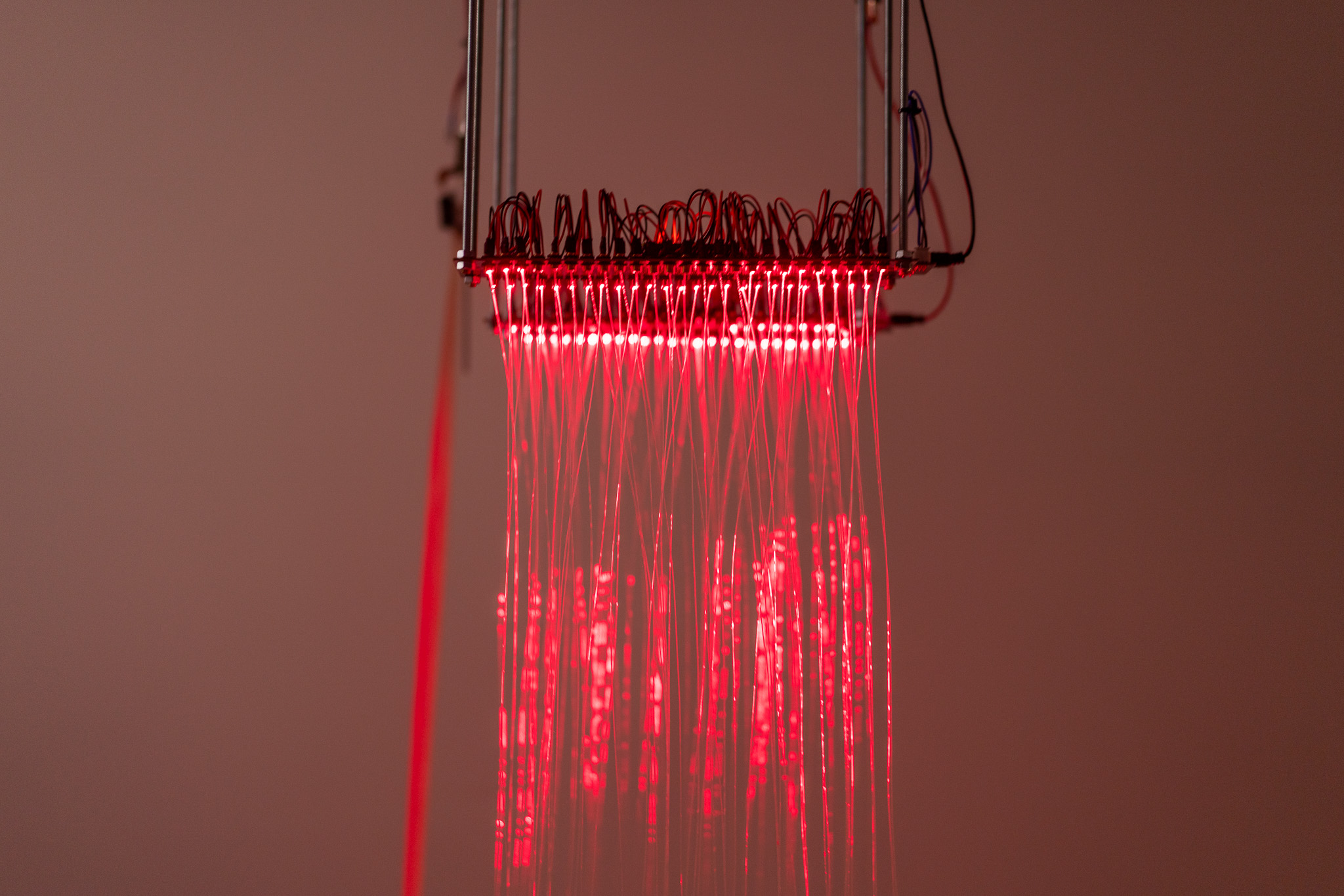
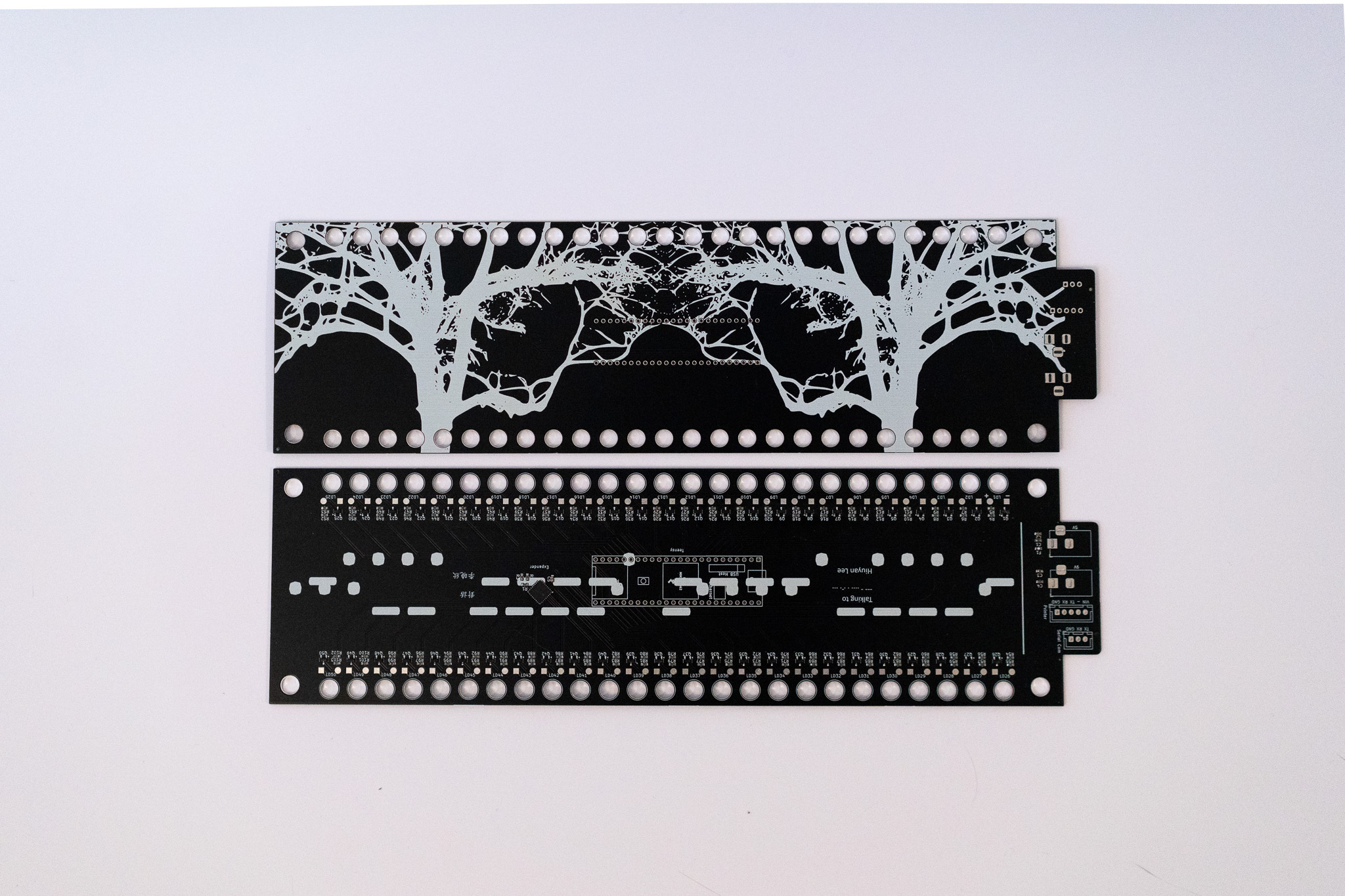
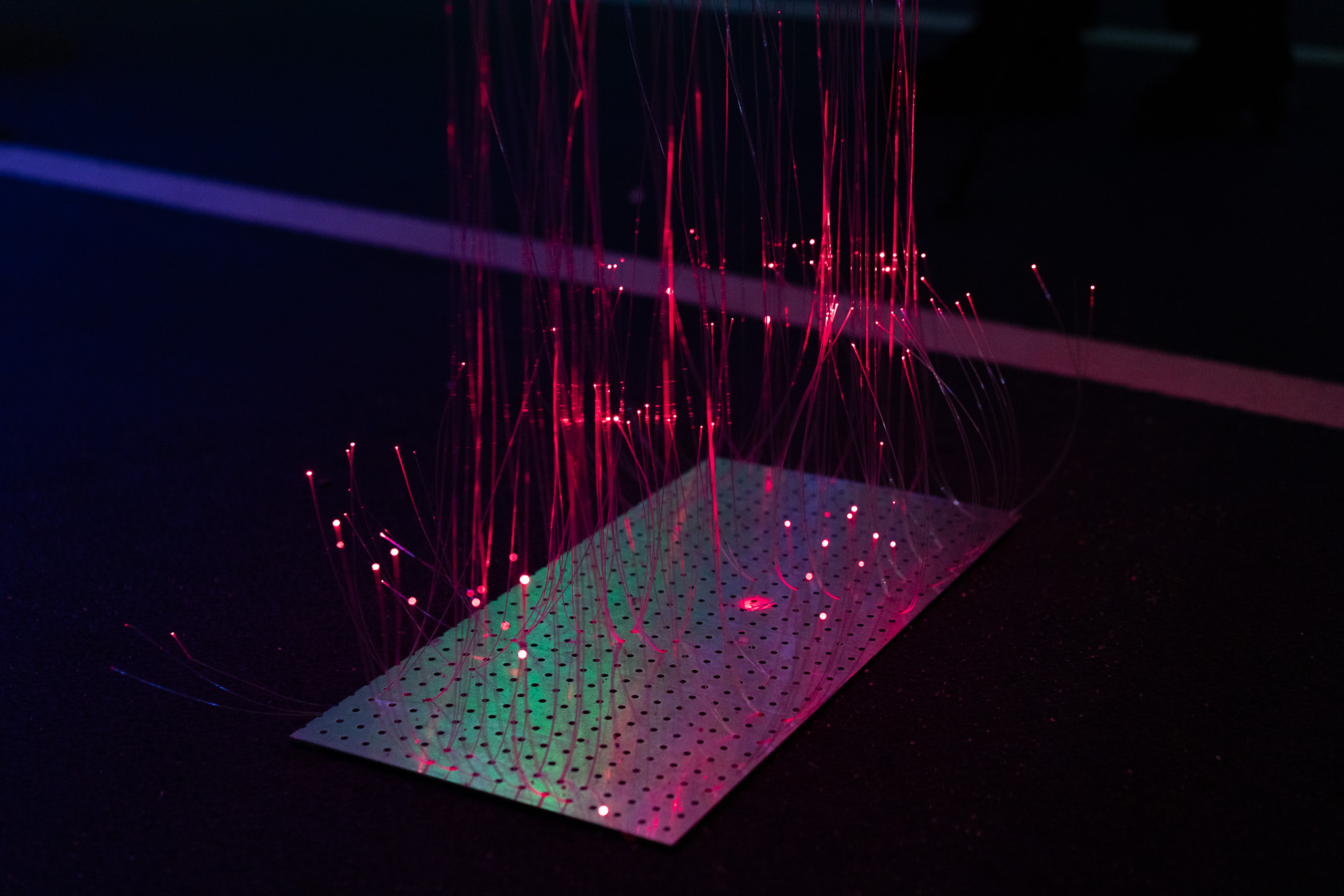
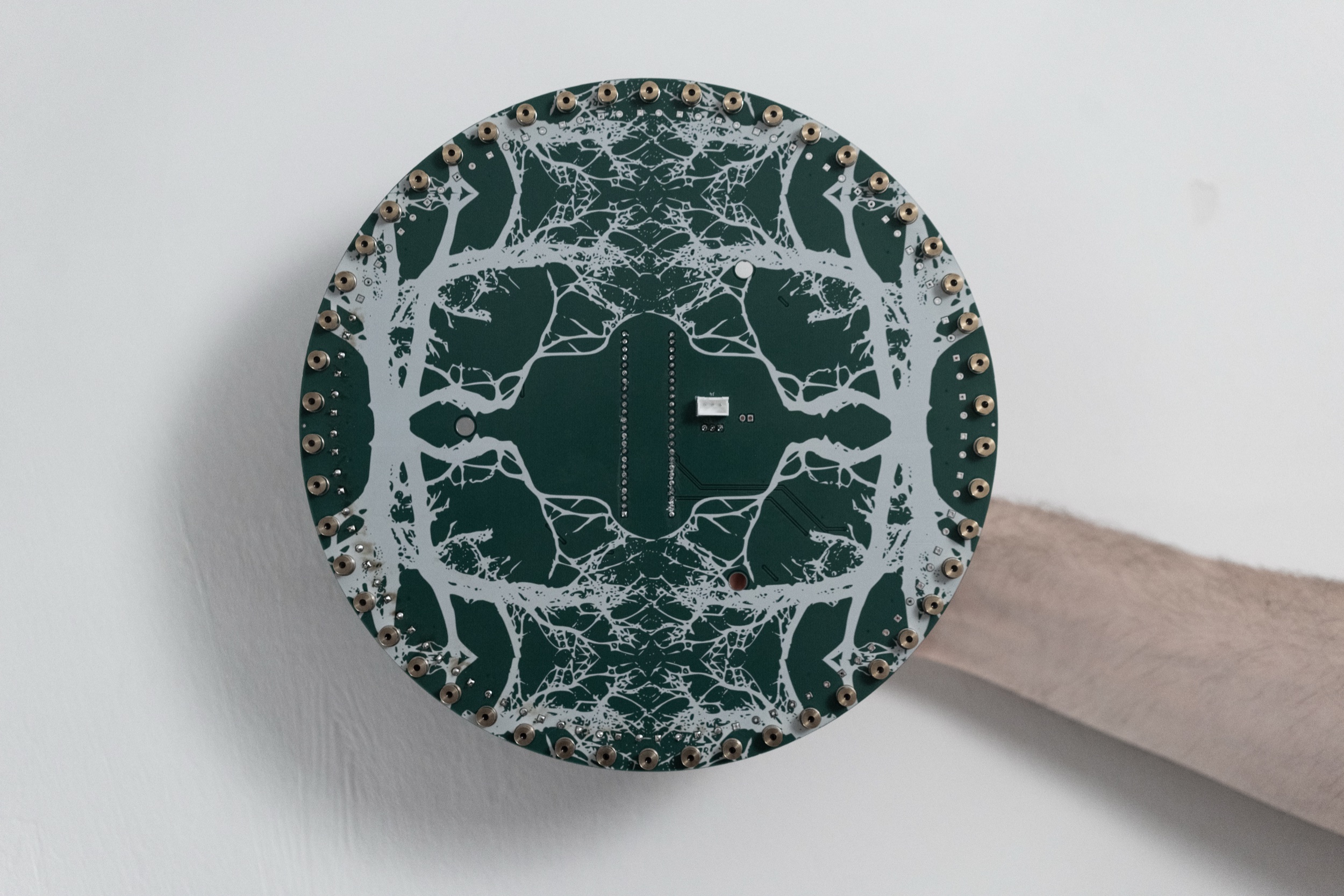
Talking to --- - … . .-. …(Others) is an electronic installation that materialises the imaginary Chinese typewriter — a machine long considered impossible. One hundred laser modules, arranged in four rows of twenty-five, are mounted on a custom printed circuit board and connected to one hundred optical fibers. The layout references the grid of the tray-bed typewriter: the same structure that engineers, inventors, and Western manufacturers spent a century declaring could not exist.
The installation transmits 背影 (Retreating Figure) by Zhu Ziqing — encoded first into the Chinese Telegraph Code, then into Morse — as pulses of red light through the fibers. The text completes its transmission in under ten seconds. At this speed, the code is impossible for human eyes to capture. The Chinese language is present in the room. It cannot be read.
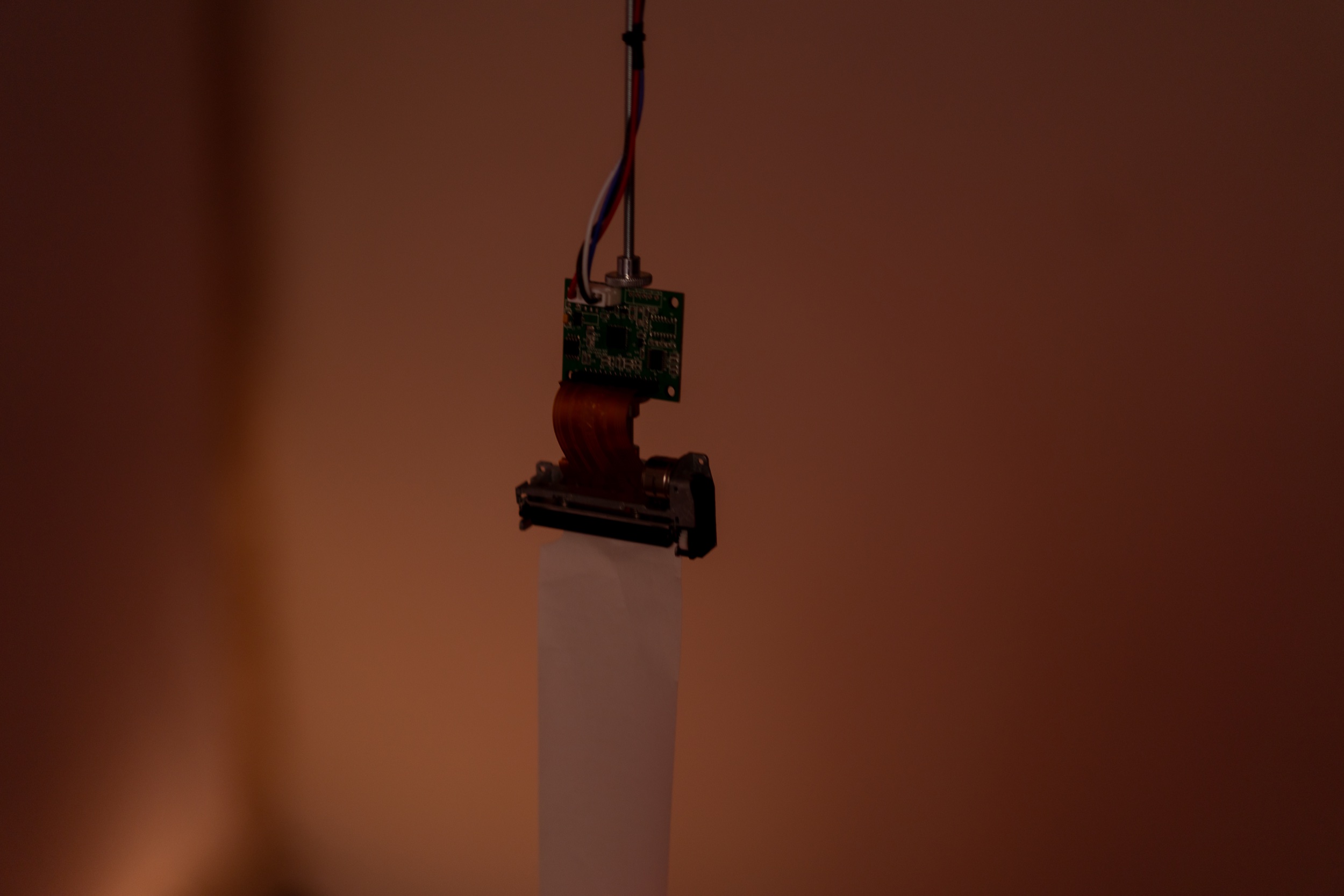
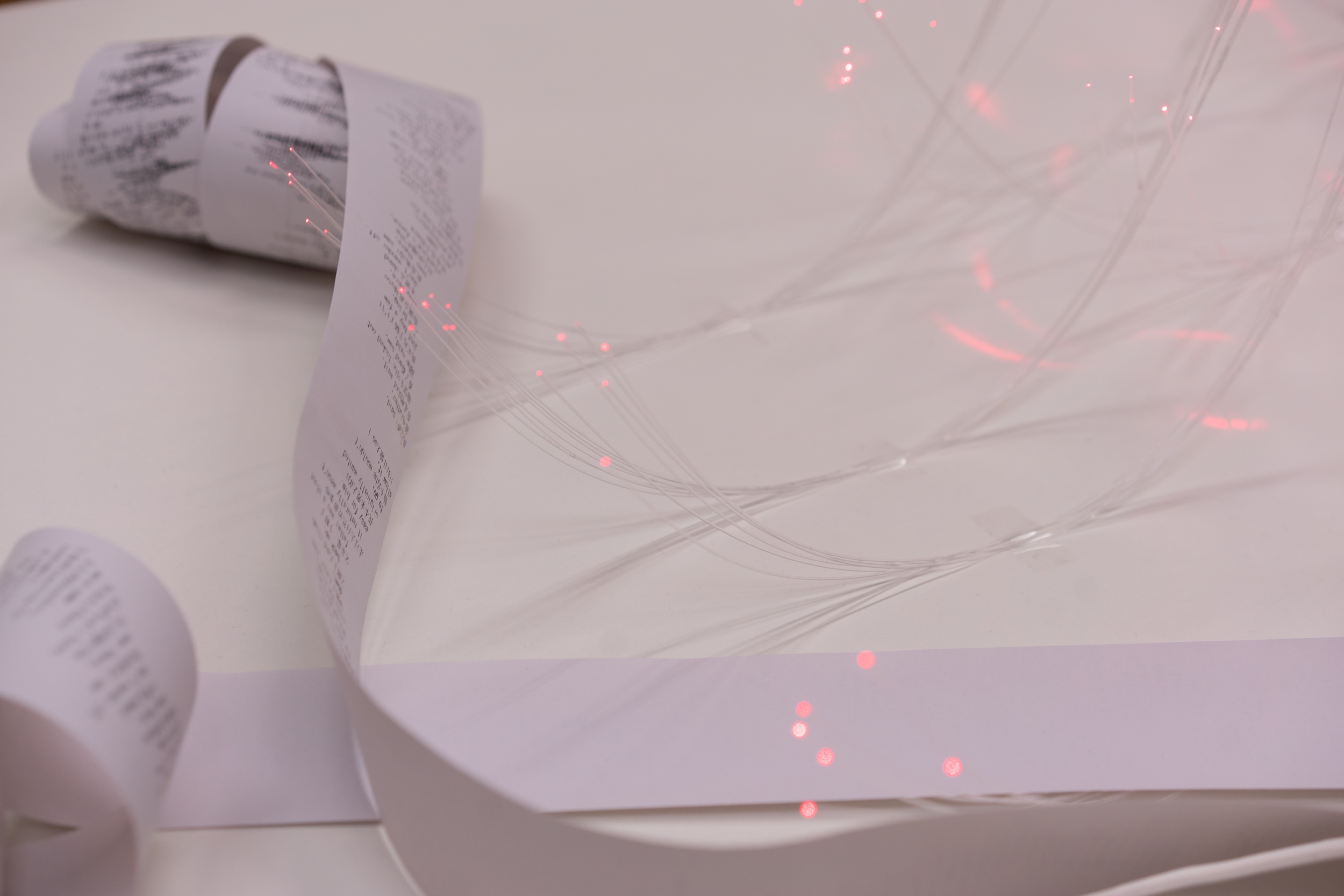
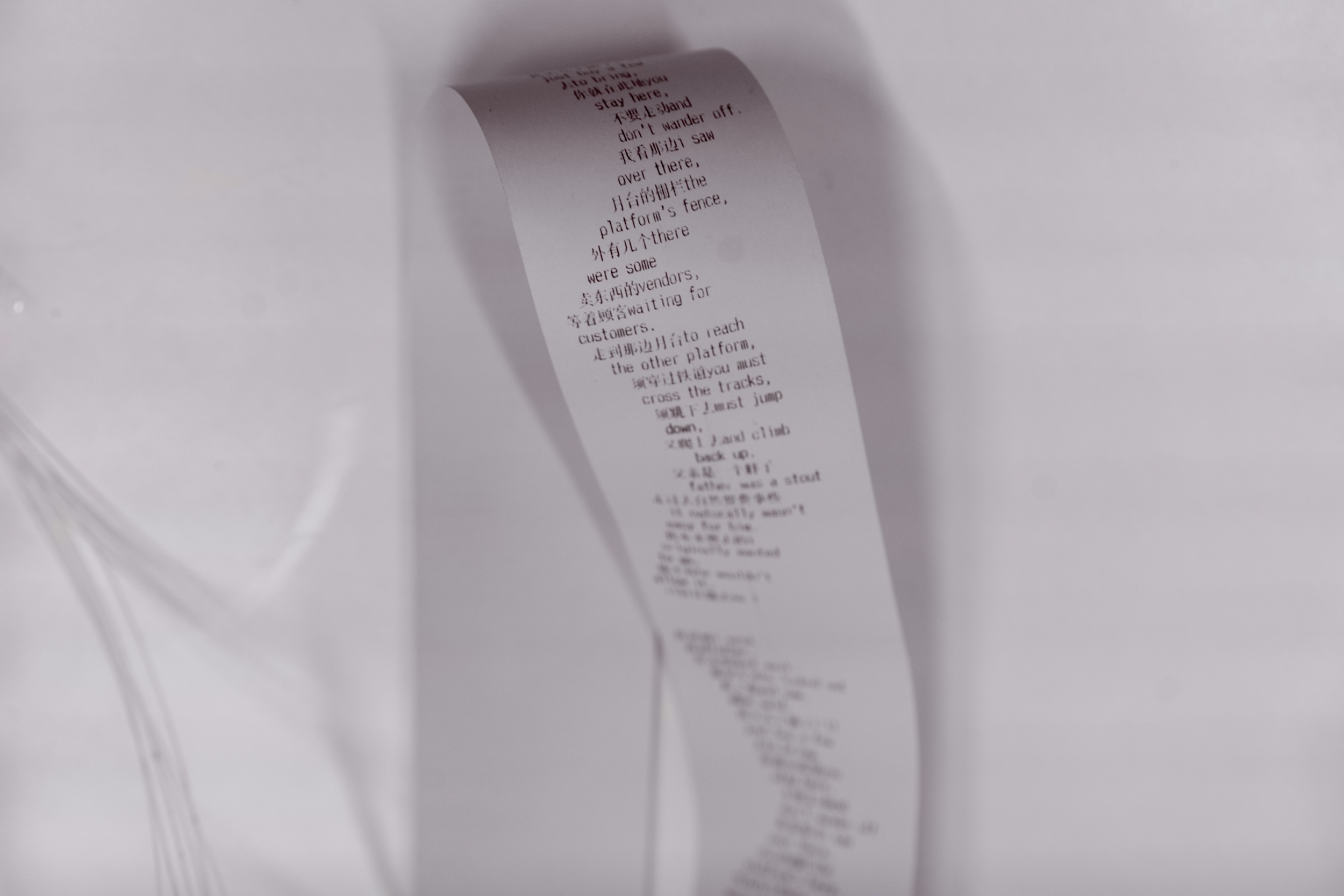
The fibers carry a second text simultaneously. The English translation of 背影 is engraved directly into the surface of the fibers as Morse code — static, physical, and equally unreadable without a codebook. The same text exists in three states at once: as light moving through the fibers, as marks cut into them, and as thermal print outputting both languages at the side of the installation — smearing as the paper feeds through at speed, the words degrading in the act of being recorded.
This work does not resolve this history. It performs it. At once a historical observation and an imaginary artifact: to exist within the same technological framework as a Latin-based language, Chinese must be encoded, reduced, and transmitted at a speed that makes it unreadable. The system functions. The language pays the cost.


Many chinese speakers- more specificly who are also chinese typist, including myself have noticed the frictions arose between “what we write” and “what we type”. In a talk on The Chinese Typewriter: A History, Thomas S. Mullaney points out that Chinese input systems are hypotext — a quasi-text that leads to a real text. To type a Chinese character or even a sentence does not require completion. You do not need to type the full character, all the strokes, to arrive at the real word — let alone pinyin, where you remember the word by its sound instead of the character itself. Typing does not equal writing. From here we might begin to understand why character amnesia (提筆忘字) is happening — the phenomenon where people can recognise a character but can no longer produce it by hand.
Even in digital archiving, Chinese has no universal cross-platform identification system. The information age arrived — but fundamentally, not for Chinese. Up until today: CTC is still used on Hong Kong and Macau ID cards. Still required for Chinese names on US visa applications. Mullaney’s research points to the problem of unambiguous cross-system identification of Chinese characters. The difficulty lies not only in the sheer size of the character set, but in the existence of single characters with multiple variant forms and pronunciations — making precise identification across systems computationally difficult. As historian Zhang Wenyang documents, the CTC codebook was never complete from the start: it could only include a selection of characters, leaving parts of the language untransmittable from the moment of its invention. Yet the CTC offers something that more modern systems do not — unambiguous indexing, particularly in international bureaucratic contexts where the receiving system cannot display or process Chinese script at all. This is why it persists on identity cards, in visa applications, in law enforcement databases worldwide.
The irony is that the system which most aggressively strips Chinese of its form — reducing a character to four arbitrary digits, cutting away its visual structure, its stroke memory, its semantic history — is also the system that most precisely identifies which character you mean. The more you reduce it, the more unambiguous it becomes. Unicode attempted to unify everything and created new ambiguities. The CTC is cruder but clearer. A system invented in 1871 to carry Chinese through a framework that was never built for it remains, over 150 years later, the most reliable answer to a question that modern computing still cannot fully resolve.
Just like the CTC on my Hongkong ID card that I thought it is left behind in the telegram era. The three sets of digits on my identity card are not a relic. They are infrastructure.

Feature
HFK Bremen Digital Media Graduation Festival 2026- 3rd Preis 39C3 Chaos Computer Congress Hamburg 2025 Link to Event